
The Board of Elementary and Secondary Education held their regular monthly meeting on Tuesday, September 30, 2025 in Everett. This was the first meeting of new Massachusetts Commissioner of Elementary and Secondary Education Pedro Martinez, who started in that position in July. The meeting agenda can be found here; a recording of the meeting can be in two parts here and here.
In addition to Commissioner Martinez, the Board was joined by two new members: student representative Isabella Chamberlain, a senior at Hudson High School; and Kristen Smidy, appointed last week by Governor Healey to the seat vacated by Michael Moriarty. Like Moriarty, Smidy comes from western Massachusetts, living in Westfield and having until this summer served as superintendent of Gateway Regional School District.
The Board opened with public comment. Most comments focused on yesterday’s release of 2025 assessment and accountability data, which can be found on the School and District Profile page as updated September 29. There were harsh words for “disappointing outcomes,” echoes of the Commissioner’s quoted description of “sobering,” and at least one call to “throw away what we’ve already done and replace the whole system.” There were also comments regarding recent harassment and doxing of teachers for comments made in private settings; the use of CORI records for school volunteers; the requirement of student teaching for licensure; the revision to the regional school regulations regarding requests for waivers; and a call for attention to equitable chapter 70 funding, noting inflation has far outpaced the inflation formula.
In his opening comments, Secretary Tutwiler opened with praise for the new faces at the table, citing Plato’s “the beginning is the most important part of the work” in the beginning that Commissioner Martinez has made. He spoke of the recently released Vision of a Graduate, which envisions “all students meeting a very high expectation” who are truly prepared “for college, careers, and civic life.” He also spoke of the work done on literacy through professional development and grants, as well as the work on career and technical education, with $100M set aside in this year’s state budget for expansion.
Commissioner Martinez said that he believes there is no other way to do a role such as his but by jumping into the deep end. He outlined the significant list of those with whom he has met since beginning in July–DESE staff, superintendents, charter leaders, legislators–as well as coming on as the co-chair of the statewide graduation council, which he said was “so many hours, so many conversations.” He praised Massachusetts summer nutrition work, saying we are one of 10 states in the country “who actually supports nutrition” and “not enough is being said about that.” He highlighted a session in Attleboro around restorative justice, embedded in best practices, in speaking of much excellent work that is going on across the state.
Martinez also did note, in response to a public discussion earlier this month, 9/11 is required to be taught in Massachusetts schools; it is part of social science curriculum in US History II.
Speaking about an item not on the agenda but raised in public comment, Vice Chair Hills spoke of the Student Opportunity Act report and questioned if the goals were robust enough. He also commented on the pattern of response to teacher comments in private settings, wondering why this is all of a sudden happening, “and maybe it’s all horrific…or maybe people are a lot more scared about the consequences.”
Matt Hills was re-elected as vice chair for this year. Chair Craven spoke about subcommittees, asking that members let her know of their preferences.
The large report of the meeting was of course the 2025 assessment and accountability results; the presentation shared can be found here.
Commissioner Martinez opened the report by stating “we always meet children where they’re at,” that is our foundational goal: regardless of what people’s opinions are of where we were in 2019
He said, “here in our Commonwealth, I seem advantages, I see alignment, I haven’t seen in other parts of the country.”
He then turned the presentation over to Chief Officer for Data, Accountability, and Assessment Rob Curtin, who started by thanking the many people involved in pulling this annual work together. He also noted that while the public release of the data was yesterday, the rolling release of student results to districts began on April 25, so districts could, as with every year, use the information in shaping their student interventions and work for this school year.
From a brief overview: in grades 3-8: there is an increase in ELA; no change in math; in grade 10, it appears there is some impact from Q 2; in science, there is no change in grade 5, with decreases in grades 8 and 10. This year was also the first year of the civics assessment in grade 8. This year, 55% of schools had either substantial progress or meeting or exceeding targets.
There are “remarkably consistent” results of around 42 percent meeting or exceeding the standard, with also consistent results of around 20 percent not meeting. In looking at the subgroup data, Martinez said that he had not seen proficiency levels this low for multilingual students; he was concerned that Massachusetts had only recently had changes allowing for best practices for multilingual students. We are behind much of the country on those practices.
In grade 10 ELA, there was a six percent drop overall, when grade 10 ELA had been approaching 2019 levels. Curtin said, “I want to be careful here about attribution,” as it is not possible for single impact
“some evidence of impact as to the outcome of question 2 in November” when we look at motivation of students to do well on the test. One way to do that is blanks or “off topic responses” in the essays; those have have substantially increased; off topic answers “tripled” from 2024 to 2025. 
Vice Chair Hills disputed the impact of the ballot question on 10th grade student outcomes. Continuing to couch his framing with care, Curtin noted that while one might expect lower results, tenth grade was trending upward until this year, getting close to 2019 results in 2024. Martinez concurred, saying “kids pay attention…when we don’t pay attention to particular things.” Curtin explained that on average in previous years, there were 800 or so off-topic per essay; this year had about 2500 per essay. In a 51 point test, if you leave two essays blank, it’s a 16 point drop (8 points each). Member Fisher added, “I think two things can be true”: the tenth grade MCAS is obsolete for accountability; it’s really problematic to hold districts accountable, given the ballot; even given that, our students are underperforming at a rate “that is beyond tragic.” Martinez agreed with the assessment, speaking of the need for a comprehensive solution. He said, “the reason Massachusetts became number one in the country, was our high standards…the gold standard” for measuring that has always been MCAS. The Department “taking [the change] as an opportunity” with more to come from the graduation council work.
In grade 10 math, the state went from almost 60% in 2019; now 45%.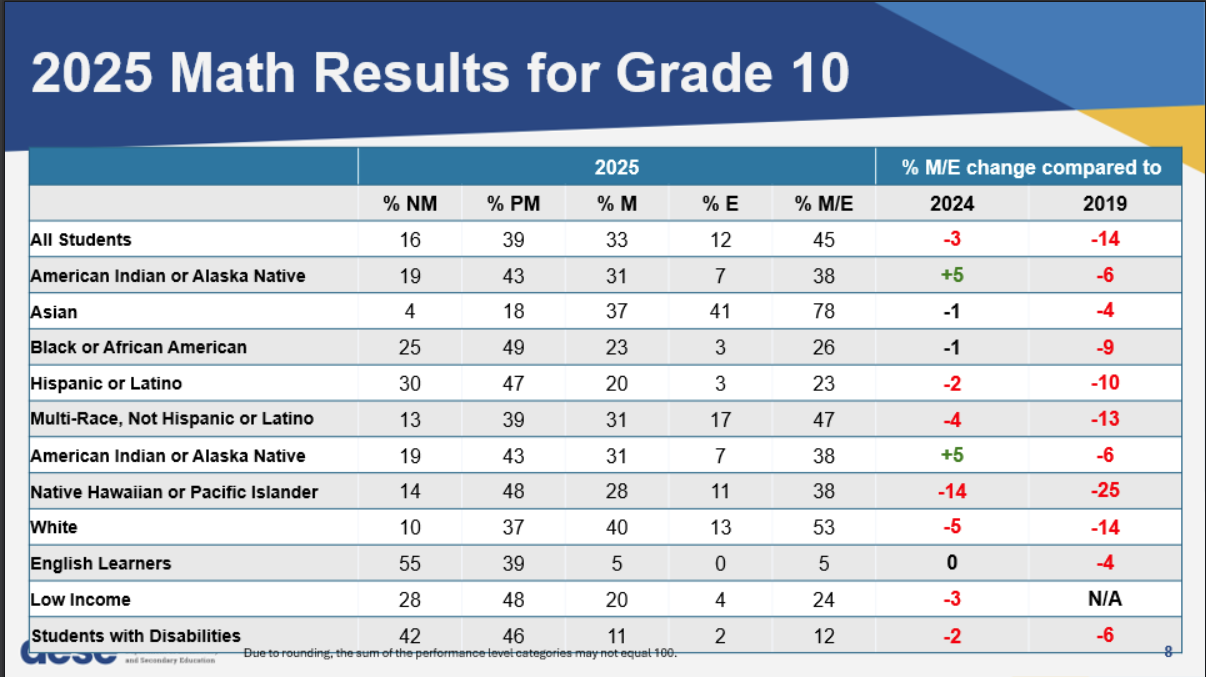
In science, 42% meeting or exceeding with grade 10, a drop much like math to 46%.
Curtin said, the “data are telling us exactly what the truth is this year.”
This was also the first operational assessment for grade 8 civics, which has two components: end of course test and a state-level performance task done locally. Curtin related that the administration went well, with almost no problems in first year of administration. Because this was the first year of the assessment, teachers met over several days in August to set what the achievement levels for the assessment should be, as is done with every state assessment. When that was then applied to the student assessments, 39% students are meeting or exceeding expectations on first administration of test. 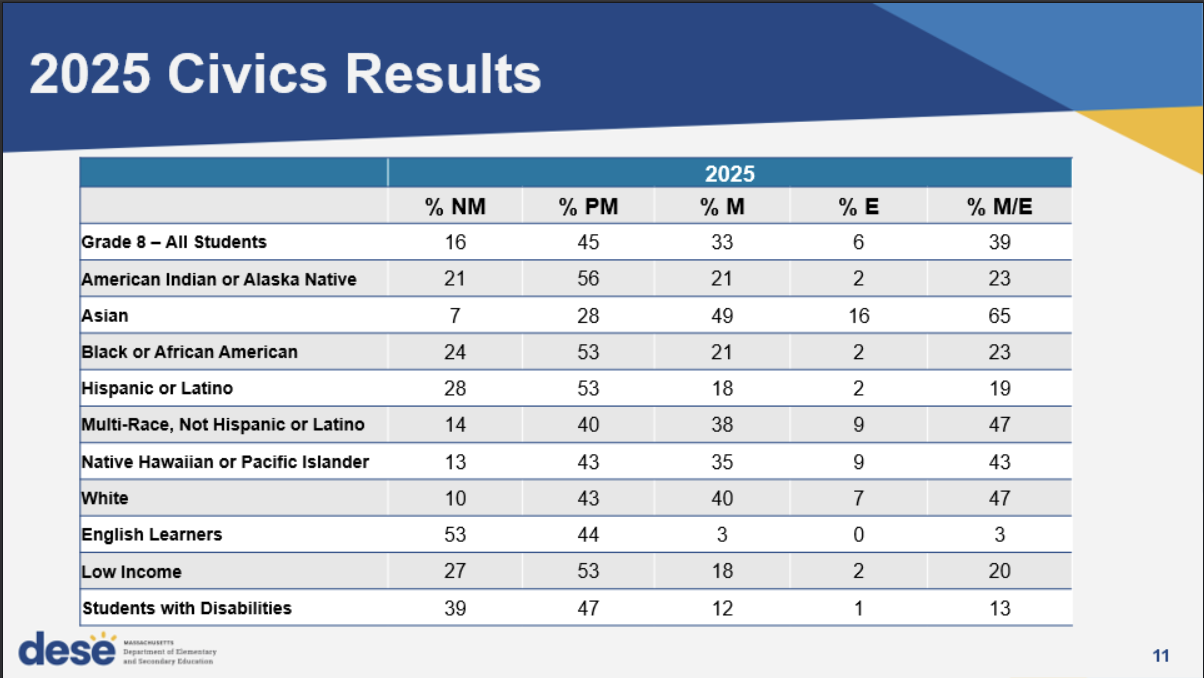
Regarding chronic absenteeism, the state saw a small improvement in results this year, recalling that at least 10% of days missed = chronic absenteeism.

In grades 3-8 for those who miss less than 10%, the average scaled score in ELA is 496 (just below meeting or exceeding), while for those chronically absent, the average scaled score is 482.
For a grade 3-8 student, not being chronically absent is worth half an achievement level, and in grade 10, it’s worth 2/3rds of an achievement level. In grade 10, it puts the average non-chronically absent student above the meeting or exceeding level.

In accountability, 63 districts have met or exceeded 2019 achievement levels in grades 3-8. Statewide, 9 districts that have done that only ELA, and 41 districts only in math, with 13 districts that have done it in both ELA and math.
Martinez said, this is not the goal but he “want[s] us to ground ourselves in where we’re at.” The celebration “yesterday is not a one and one…[we will be] elevating practices throughout the year.” In the discussion of what districts are doing to raise levels, “nobody talked about test prep…nobody talked about this drill…teachers will stop tier one instruction and go right to remediation…that’s not what was talked about…[they talked about] a lot of hard work and really trying different things.” He said high amounts of turnover at the classroom or district level makes it “all for naught.” He said with “so many assets…I do see a path forward.”
Member Christina Grant said it was “eye opening to see this data against the level of resources that have been invested.” There were brief interchanges about aligned curriculum and the relative socioeconomic status of the districts. Member Dálida Rocha spoke of the need for students to feel connected and ensuring students are appropriately supported. Martinez said that yesterday, “We talked about students feeling joy, feeling a sense of community.” Grant questioned if parents understood the impact of 30 days of absence, weighing it against the “tremendous investment” that the taxpayers of this Commonwealth have made. Questioning the joy aspect, she spoke of the need to “hold people accountable.” Martinez said, “joy is students feeling confident about their future.”
Regarding accountability levels, Curtin reminded the Board that this has two aspects, which respond to two questions:
• “does a school require assistance or intervention or not?”
• “how schools are doing relative to making their targets?”
The Department is not talking today about individual school decisions regarding chronically underperforming or underperforming announcements; they will bring those back to Board perhaps as early as next month. What can be shared at this point is that 82% not requiring assistance or intervention of those so measured, and 18% are requiring assistance or intervention. Additionally, there are six Blue Ribbon Schools (recognized as such despite the federal government dropping the program) and 61 schools of recognition; the full list can be found online here.
The Board then moved to the proposed amendments to regulations regarding regional schools. As a reminder, these are a collection of technical amendments as outlined back in April here. A strikethrough edition of the amendments as placed before the Board can be found here. Six public comments were received, a summary of which can be found here. After a brief presentation, the Board passed the amendments unanimously.
Finally, the Board took up the proposed adjustment of conditions on the Felix Commonwealth Virtual School, which plans to open in Fall 2026. This was approved by the Board.
The Board then adjourned. They will next meet on October 27.