The Board of Elementary and Secondary Education held their regular monthly meeting on Tuesday, December 16 at 9 AM. The agenda can be found here; video of the meeting is available here.
The Board opened with public comment. Most speakers were Student Ambassadors in adult learning programs across the state, who spoke to their own experiences with the programs; as the first said, “I am one of the faces of adult education in Massachusetts.” They spoke of the confidence they found, the pride in themselves and from their families, the abilities and capacities they have. Another said, “[these programs] not only impact our lives; they impact the lives of our families.” They spoke of the Student Ambassador program now allowing them to provide tutoring for others. One spoke of the hope brought into her home through the program. As one closed, “This beautiful memory is carried on my heart.”
Jessica Tang, President of AFT-MA, first congratulated 2026 Massachusetts Teacher of the Year Tara Goodhue, a science teacher in Lowell. She also spoke of the fiscal crisis facing making schools, in part due to drops in enrollment due to the pervasive fear in communities. She asked the state work on a grant program to fill fiscal gaps. Saying that she understood that both UP Academy Holland and the Dearborn STEM Academy were to be released from levels of oversight, she spoke of the commitment of staff to the work to continue to help those schools thrive.
Further testimony also focused on UP Academy, from a parent seeking exit assurances, from the school leadership, and from UP Education Network leadership, which spoke of the need for exiting well.
There was also comment on accountability and on supporting gifted students.
In his opening comments, Secretary Tutwiler said, speaking of the adult learners, that the Department’s charge is to support people to realize their dreams, which “happens because of the hard work of those who are leading that effort,” and said to the learners themselves, “you are welcome to come back every month.”
Commissioner Martinez, noting that he is in his sixth month, said that he is “beginning to get the hang of the geography” of the state. He announced that two schools are exiting “underperforming” status: Fonseca School in Fall River and the Dearborn STEM Academy in Boston. UP Academy Holland will be exiting state receivership at the end of the school year. In later discussion, Martinez noted that these will involve “exit assurances” created in collaboration with the district, which will continue for up to two years.
Vice Chair Hills, observing that the Board received the Student Opportunity Act Data Advisory Council year end report on their “other items for information” asked for better information on what is working and what is not. Member Smidy, who very recently was a superintendent, commented that only meeting twice and only having one district representative, raised questions on utility, and further, given how much time is spent on those reports in districts. She asked, “or if the information isn’t used, why have districts submit those reports?” Chair Craven noted that in recent years, advisory councils have been relegated to the end of the agenda, and she intends to change that, as “it’s either worth it to do it or it’s not.”
The Board next heard from 2026 Massachusetts Teacher of the Year Tara Goodhue. Dr. Goodhue spoke of her mother’s being a teacher, and of her taking a class at Clark University, from which she graduated, on urban schooling; she knew that she wanted to become a teacher in a city school. She said that she is inspired by her students, and that they make her laugh every day. While as a teacher, it is “really easy to feel overwhelmed,” she said she is “committed to spreading a message of hope,” as “we cannot stand frozen as the forest burns.” She was warmly thanked by Board members for her remarks and her service.
Wyvonne Stevens-Carter, who leads adult education in the Department, next updated the Board on that work. This year, programs will reach over 27,000 adult learners across the state, who are adults going back to school, immigrants, people working full time gaining certifications, people exiting prison, and more. There are programs throughout the state and now online. The largest number of students are between the ages of 25-29. They put learners first, working to ensure that when there are funding cuts, students are not impacted. The program has had and continues to have a waitlist; having conversation clubs run by student ambassadors like those who spoke during public comment was a student-created idea. Member Smidy noted that this sector is really “living the DESE educational vision.” as the work that is being done is not compliance-focused; it’s support focused.
Commissioner Martinez presented his proposed priorities. Having met 2700 stakeholders and attended over 50 events in his six months on the job, he presented this to the Board today for their feedback. Presenting a slide that showed that “no MA student group is at pre-pandemic levels on the MCAS” and, while “the rest of the country is making progress,” Massachusetts has the
“worst of both worlds: we’re overall lower, and our gaps are still wider.” His proposed priorities are:
• Power of Presence: increasing student attendance and engagement
• Literacy Launch: strengthening evidence-based early literacy practices
• Future Focused: expanding college and career pathways
• Inclusive Impact: strengthening evidence-based practices for students with disabilities and English learners
• Teach Tomorrow: building a robust teacher pipeline
• Accelerating Achievement: providing comprehensive support for low–performing schools
He intends them to move these into a five year strategic plan, which will come to the Board.
Additionally, he has found that the Department lacks internal coherence. In order to change that, he is restructuring the Department, as follows:
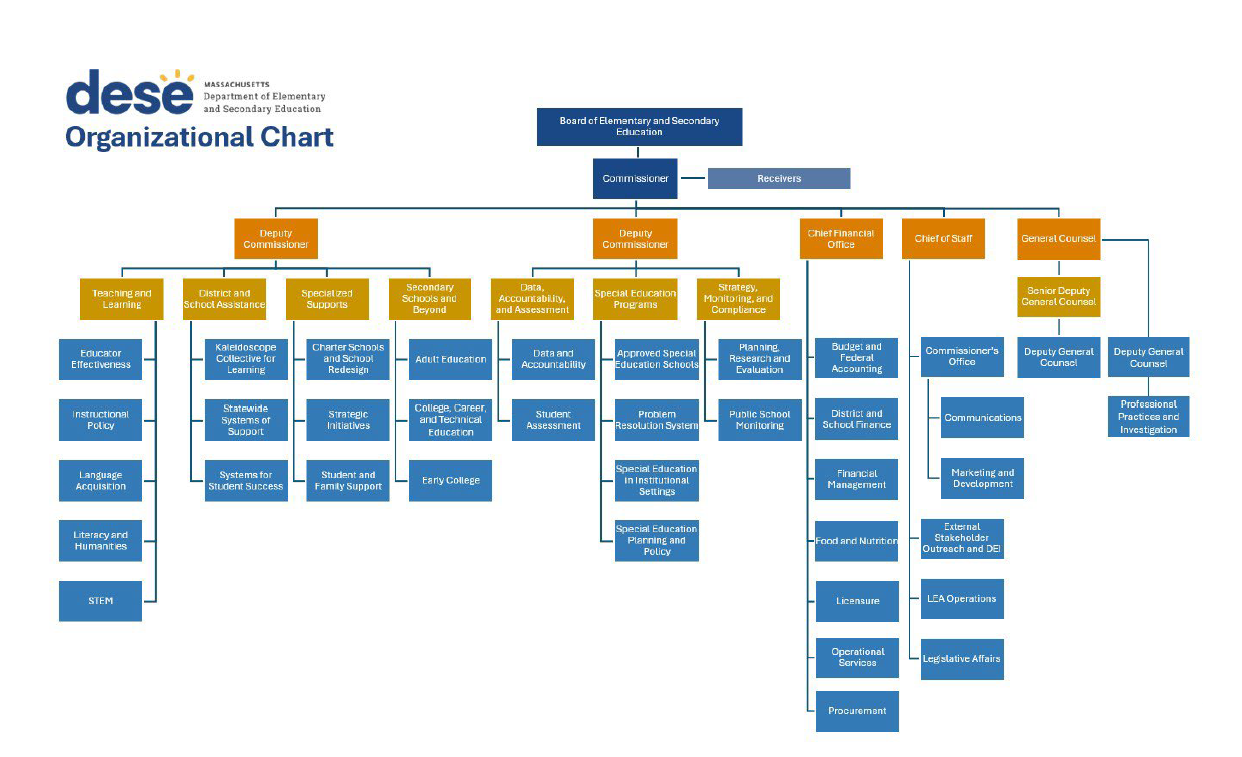
The two new deputy commissioners are Lauren Woo and Rob Curtin; Erin Hashimoto-Martell is the senior associate commissioner for teaching and learning, and Darcy Fernandes the senior associate commissioner for specialized support. The remaining senior associate commissioner positions are open both internally and externally. The Commissioner said all of this is within the Department’s budget.
While there was not feedback on the specific named items, members did discuss the presentation more generally. Member Mohamed requested that there be very specific benchmarks for implementation. To that, the Commissioner noted that there is a clear indication in the state’s data that meeting the state’s benchmarks “at some point” is the clearest indicator we have for college, and said that plus MassCore was key; he said, “unapologetically, we have to double-down.” Member Rocha asked what would be measured, when the MCAS is not required for high school graduation. Commenting that it was the high standards of Massachusetts, as measured by the MCAS, that allowed the leadership it has, he further observed that it is the end of course exams that were the subject of much discussion in the graduation council. He emphasized the “importance of mastery” and said we have to be “really crystal clear with parents…importance of standards and of student achievement…that’s something I am going to be very emphatic about.” Vice Chair Hills then spoke of the “chasm” between how parents think their children are doing in school and how they are doing in school, saying that they needed to put out metrics on how quickly objectives were being met. Martinez said, “working with districts,” he wants to be “clear about what success means.” Member Grant said we “cannot skirt powers” given Board and Commissioner under state law, that “during the pandemic, there were historic investments made, and we do not have data” showing results, and that the Board and Commissioner have “powers to hold individual schools accountable.” Hills and Member West got into a three-way discussion about the work of Thomas Kane at Harvard and the degree to which it could be tied to individual interventions, their impacts, and the timeliness of reporting.
Finally, the Board took up the interim report of the Statewide Graduation Council.
Secretary Tutwiler opened the presentation, reviewing the charge of the Council:
• What should students know and be able to do before they graduate?
• How should students demonstrate their achievements in ways that accurately reflect their skills and knowledge?
• What conditions should be in place to promote meaningful and equitable student experiences?
This began with stakeholder engagement in the spring. A vision of a graduate was released in September, and the interim report was released earlier this month. The final recommendations are due in June 2026.
The Vision of a Massachusetts Graduate, as envisioned:
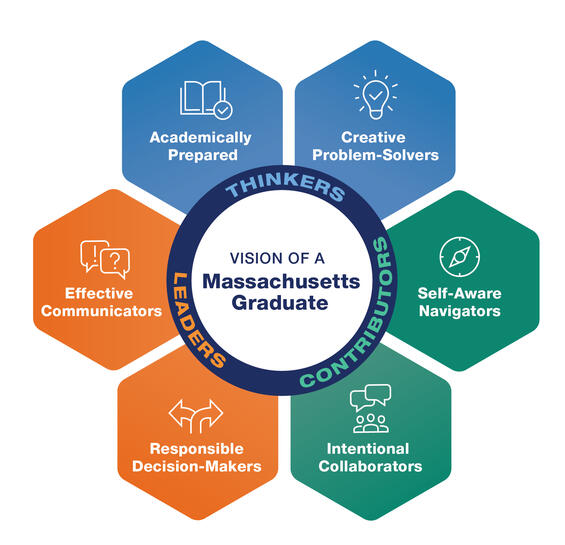
Tutwiler said that this reflects “what we want all students to know and be able to do.”
Commissioner Martinez said that this is about students being able to take advantage of all the Commonwealth has to offer. High schools should give students strong foundations, proven skills, and bright futures. He said that this is not a list of items, but a comprehensive package: students will complete a rigorous program of study; will participate in end-of-course assessments connected to specific courses that will be designed, administered, and scored by the state; and will complete a capstone or portfolio that is defined by the state, and designed, administered, and scored locally; will develop and maintain an individual career and academic plan, will complete the FAFSA or opt out; will demonstrate financial literacy; and will be able to earn seals of distinction.
Failure to pass an end of course assessment alone will not prevent graduation; how the end of course assessment will interact with the rest of this is still to be further spelled out with the Council.
Martinez said, “the challenge is scale,” as many aspects of this are things that are being done in districts already.
West said he was “favorably impressed” by the Council’s work. He emphasized that students being “academically prepared” was the core mission of schools. He said he also really liked the inclusion of exit exams. He said he did not think that a portfolio or capstone does not fit under a demonstration of mastery, particularly if they are locally scored; he likened that to “ensuring an engaging student experience.” He asked about timing of implementation, recognizing that some of this will require legislation. He asked about the information collected about grades of students and MCAS scores for alignment, as that will help to make the case of the need for exit exams.
Martinez responded that the policies being put into place in districts are in place for this year and will be in place for next year.
Curtin said the Department is in the process of collecting district policies. The work West mentions will not be in place until the class of 2026.
Hills noted that not all students would have passed the MCAS now. Curtin responds that most students in the class of 2026 have passed the MCAS and had already.
Hills said this is all woven together, but said implementation may vary, and suggested that the Commissioner should consider if some of this can be tiered. He suggested much of this could be done in regulation. He said that the report is internally contradictory on the exit exams and suggested it has had too many editors: the exit exam counting towards graduation or not.
Martinez further explained that this is where they’ll bring in the practioners to spell out what happens if a student does fail an exit exam. Hills said that language has changed since December 1. The language was then further discussed by the Board.
Grant noted that it is hard to have high quality end of course assessment that are state wide. She said, “the devil is in the implementation moving forward.”
Smidy spoke of the alignment of local requirements and state requirements. Martinez said that those details are going to be worked out over the next several months. He said, “Directionally, this is it” and it is not being revisited. “It’s not okay to have students graduating in the Commonwealth who don’t have access to public [higher] education,” he said. “Our commitment is, it will be done with the field…it’s the ‘how'” Smidy further noted that teacher pipeline work matters here, as well, as some districts do not have teachers to teach particular courses.
Fisher notes that portfolios and capstones are expensive and require “a tremendous amount of resources.” She said, in her work, they refer to it “as high impact educational experiences.” She said, “I have great fear it will become unfunded mandate…but I want it for everyone.” She asked, “Where is it coming from, when we heard about the fiscal cliff, where is it coming from?”
Martinez said they can ask what it took in terms of resources.
Tutwiler followed by saying, “this is a statement of values.”
Rocha noted that this doesn’t start in high school; students must be prepared before high school. She said that the pipeline of counselors is important for this work, too.
Martinez noted that the biggest request from superintendents is letting school committees and parents know that this will not be in place for next school year.
Craven said that there is already money in the system and asked how structures could change if there are fewer students, spending “$40,000 or $50,000 per student.” Smidy said that she is hearing people committed to doing it right.
The Board next meets on January 27, 2026.

MASC Mourns the Passing of Former Executive Director Paul Gorden
A New Venue for the 2026 MASC/MASS Conference
Public Policy Updates: February 2025 Board of Elementary and Secondary Education
Public Policy Updates: Governor Releases FY27 Budget Proposal
Public Policy Updates: January 2026 Board of Elementary and Secondary Education
Public Policy Updates: December 2025 Board of Elementary and Secondary Education
Press Release: MASC President Statement on New Statewide High School Graduation Framework
2025 Delegate Assembly: Report on Actions Taken
SOS for Rural Schools – Your Advocacy Needed
Public Policy Reports: November 2025 Board of Elementary and Secondary Education
Public Policy Updates: December 2025 Board of Elementary and Secondary Education
The Board of Elementary and Secondary Education held their regular monthly meeting on Tuesday, December 16 at 9 AM. The agenda can be found here; video of the meeting is available here.
The Board opened with public comment. Most speakers were Student Ambassadors in adult learning programs across the state, who spoke to their own experiences with the programs; as the first said, “I am one of the faces of adult education in Massachusetts.” They spoke of the confidence they found, the pride in themselves and from their families, the abilities and capacities they have. Another said, “[these programs] not only impact our lives; they impact the lives of our families.” They spoke of the Student Ambassador program now allowing them to provide tutoring for others. One spoke of the hope brought into her home through the program. As one closed, “This beautiful memory is carried on my heart.”
Jessica Tang, President of AFT-MA, first congratulated 2026 Massachusetts Teacher of the Year Tara Goodhue, a science teacher in Lowell. She also spoke of the fiscal crisis facing making schools, in part due to drops in enrollment due to the pervasive fear in communities. She asked the state work on a grant program to fill fiscal gaps. Saying that she understood that both UP Academy Holland and the Dearborn STEM Academy were to be released from levels of oversight, she spoke of the commitment of staff to the work to continue to help those schools thrive.
Further testimony also focused on UP Academy, from a parent seeking exit assurances, from the school leadership, and from UP Education Network leadership, which spoke of the need for exiting well.
There was also comment on accountability and on supporting gifted students.
In his opening comments, Secretary Tutwiler said, speaking of the adult learners, that the Department’s charge is to support people to realize their dreams, which “happens because of the hard work of those who are leading that effort,” and said to the learners themselves, “you are welcome to come back every month.”
Commissioner Martinez, noting that he is in his sixth month, said that he is “beginning to get the hang of the geography” of the state. He announced that two schools are exiting “underperforming” status: Fonseca School in Fall River and the Dearborn STEM Academy in Boston. UP Academy Holland will be exiting state receivership at the end of the school year. In later discussion, Martinez noted that these will involve “exit assurances” created in collaboration with the district, which will continue for up to two years.
Vice Chair Hills, observing that the Board received the Student Opportunity Act Data Advisory Council year end report on their “other items for information” asked for better information on what is working and what is not. Member Smidy, who very recently was a superintendent, commented that only meeting twice and only having one district representative, raised questions on utility, and further, given how much time is spent on those reports in districts. She asked, “or if the information isn’t used, why have districts submit those reports?” Chair Craven noted that in recent years, advisory councils have been relegated to the end of the agenda, and she intends to change that, as “it’s either worth it to do it or it’s not.”
The Board next heard from 2026 Massachusetts Teacher of the Year Tara Goodhue. Dr. Goodhue spoke of her mother’s being a teacher, and of her taking a class at Clark University, from which she graduated, on urban schooling; she knew that she wanted to become a teacher in a city school. She said that she is inspired by her students, and that they make her laugh every day. While as a teacher, it is “really easy to feel overwhelmed,” she said she is “committed to spreading a message of hope,” as “we cannot stand frozen as the forest burns.” She was warmly thanked by Board members for her remarks and her service.
Wyvonne Stevens-Carter, who leads adult education in the Department, next updated the Board on that work. This year, programs will reach over 27,000 adult learners across the state, who are adults going back to school, immigrants, people working full time gaining certifications, people exiting prison, and more. There are programs throughout the state and now online. The largest number of students are between the ages of 25-29. They put learners first, working to ensure that when there are funding cuts, students are not impacted. The program has had and continues to have a waitlist; having conversation clubs run by student ambassadors like those who spoke during public comment was a student-created idea. Member Smidy noted that this sector is really “living the DESE educational vision.” as the work that is being done is not compliance-focused; it’s support focused.
Commissioner Martinez presented his proposed priorities. Having met 2700 stakeholders and attended over 50 events in his six months on the job, he presented this to the Board today for their feedback. Presenting a slide that showed that “no MA student group is at pre-pandemic levels on the MCAS” and, while “the rest of the country is making progress,” Massachusetts has the

“worst of both worlds: we’re overall lower, and our gaps are still wider.” His proposed priorities are:
• Power of Presence: increasing student attendance and engagement
• Literacy Launch: strengthening evidence-based early literacy practices
• Future Focused: expanding college and career pathways
• Inclusive Impact: strengthening evidence-based practices for students with disabilities and English learners
• Teach Tomorrow: building a robust teacher pipeline
• Accelerating Achievement: providing comprehensive support for low–performing schools
He intends them to move these into a five year strategic plan, which will come to the Board.
Additionally, he has found that the Department lacks internal coherence. In order to change that, he is restructuring the Department, as follows:
The two new deputy commissioners are Lauren Woo and Rob Curtin; Erin Hashimoto-Martell is the senior associate commissioner for teaching and learning, and Darcy Fernandes the senior associate commissioner for specialized support. The remaining senior associate commissioner positions are open both internally and externally. The Commissioner said all of this is within the Department’s budget.
While there was not feedback on the specific named items, members did discuss the presentation more generally. Member Mohamed requested that there be very specific benchmarks for implementation. To that, the Commissioner noted that there is a clear indication in the state’s data that meeting the state’s benchmarks “at some point” is the clearest indicator we have for college, and said that plus MassCore was key; he said, “unapologetically, we have to double-down.” Member Rocha asked what would be measured, when the MCAS is not required for high school graduation. Commenting that it was the high standards of Massachusetts, as measured by the MCAS, that allowed the leadership it has, he further observed that it is the end of course exams that were the subject of much discussion in the graduation council. He emphasized the “importance of mastery” and said we have to be “really crystal clear with parents…importance of standards and of student achievement…that’s something I am going to be very emphatic about.” Vice Chair Hills then spoke of the “chasm” between how parents think their children are doing in school and how they are doing in school, saying that they needed to put out metrics on how quickly objectives were being met. Martinez said, “working with districts,” he wants to be “clear about what success means.” Member Grant said we “cannot skirt powers” given Board and Commissioner under state law, that “during the pandemic, there were historic investments made, and we do not have data” showing results, and that the Board and Commissioner have “powers to hold individual schools accountable.” Hills and Member West got into a three-way discussion about the work of Thomas Kane at Harvard and the degree to which it could be tied to individual interventions, their impacts, and the timeliness of reporting.
Finally, the Board took up the interim report of the Statewide Graduation Council.
Secretary Tutwiler opened the presentation, reviewing the charge of the Council:
• What should students know and be able to do before they graduate?
• How should students demonstrate their achievements in ways that accurately reflect their skills and knowledge?
• What conditions should be in place to promote meaningful and equitable student experiences?
This began with stakeholder engagement in the spring. A vision of a graduate was released in September, and the interim report was released earlier this month. The final recommendations are due in June 2026.
The Vision of a Massachusetts Graduate, as envisioned:
Tutwiler said that this reflects “what we want all students to know and be able to do.”
Commissioner Martinez said that this is about students being able to take advantage of all the Commonwealth has to offer. High schools should give students strong foundations, proven skills, and bright futures. He said that this is not a list of items, but a comprehensive package: students will complete a rigorous program of study; will participate in end-of-course assessments connected to specific courses that will be designed, administered, and scored by the state; and will complete a capstone or portfolio that is defined by the state, and designed, administered, and scored locally; will develop and maintain an individual career and academic plan, will complete the FAFSA or opt out; will demonstrate financial literacy; and will be able to earn seals of distinction.
Failure to pass an end of course assessment alone will not prevent graduation; how the end of course assessment will interact with the rest of this is still to be further spelled out with the Council.
Martinez said, “the challenge is scale,” as many aspects of this are things that are being done in districts already.
West said he was “favorably impressed” by the Council’s work. He emphasized that students being “academically prepared” was the core mission of schools. He said he also really liked the inclusion of exit exams. He said he did not think that a portfolio or capstone does not fit under a demonstration of mastery, particularly if they are locally scored; he likened that to “ensuring an engaging student experience.” He asked about timing of implementation, recognizing that some of this will require legislation. He asked about the information collected about grades of students and MCAS scores for alignment, as that will help to make the case of the need for exit exams.
Martinez responded that the policies being put into place in districts are in place for this year and will be in place for next year.
Curtin said the Department is in the process of collecting district policies. The work West mentions will not be in place until the class of 2026.
Hills noted that not all students would have passed the MCAS now. Curtin responds that most students in the class of 2026 have passed the MCAS and had already.
Hills said this is all woven together, but said implementation may vary, and suggested that the Commissioner should consider if some of this can be tiered. He suggested much of this could be done in regulation. He said that the report is internally contradictory on the exit exams and suggested it has had too many editors: the exit exam counting towards graduation or not.
Martinez further explained that this is where they’ll bring in the practioners to spell out what happens if a student does fail an exit exam. Hills said that language has changed since December 1. The language was then further discussed by the Board.
Grant noted that it is hard to have high quality end of course assessment that are state wide. She said, “the devil is in the implementation moving forward.”
Smidy spoke of the alignment of local requirements and state requirements. Martinez said that those details are going to be worked out over the next several months. He said, “Directionally, this is it” and it is not being revisited. “It’s not okay to have students graduating in the Commonwealth who don’t have access to public [higher] education,” he said. “Our commitment is, it will be done with the field…it’s the ‘how'” Smidy further noted that teacher pipeline work matters here, as well, as some districts do not have teachers to teach particular courses.
Fisher notes that portfolios and capstones are expensive and require “a tremendous amount of resources.” She said, in her work, they refer to it “as high impact educational experiences.” She said, “I have great fear it will become unfunded mandate…but I want it for everyone.” She asked, “Where is it coming from, when we heard about the fiscal cliff, where is it coming from?”
Martinez said they can ask what it took in terms of resources.
Tutwiler followed by saying, “this is a statement of values.”
Rocha noted that this doesn’t start in high school; students must be prepared before high school. She said that the pipeline of counselors is important for this work, too.
Martinez noted that the biggest request from superintendents is letting school committees and parents know that this will not be in place for next school year.
Craven said that there is already money in the system and asked how structures could change if there are fewer students, spending “$40,000 or $50,000 per student.” Smidy said that she is hearing people committed to doing it right.
The Board next meets on January 27, 2026.