
Today’s regular monthly meeting of the Board of Elementary and Secondary Education was fully remote due to the weather. The agenda is here; the recorded livestream is here.
Today’s meeting included Acting Secretary of Education Amy Kershaw, the Commissioner of Early Education and Care, who is serving in that role until Stephen Zrike becomes Secretary in March.
The Board opened with public comment. Public comment reflected concerns on small non-rural district state aid; appropriate training and testing for teachers on literacy; students not meeting MassCore requirements; gifted students; and the possible ballot question rolling back the income tax. There was also testimony from several involved in the Pioneer Valley Chinese Immersion Charter School regarding the conditions under which their charter was renewed.
Former Secretary Tutwiler briefly attended, and Chair Katherine Craven, Vice Chair Matt Hills, and Commissioner Pedro Martinez praised his service as Secretary.
Vice Chair Hills spoke briefly on the state’s response to teacher strikes. It emerged that he has sent a letter to the Commissioner proposing that the state waiver the 180 days required for students in school districts where teachers strike and that teachers not be paid for the days missed. The full letter can be found online here.
The Board then turned to an update on early literacy, which was the main topic of the meeting. The presentation given at the meeting can be found online here. In overview, the presentation covered the following:

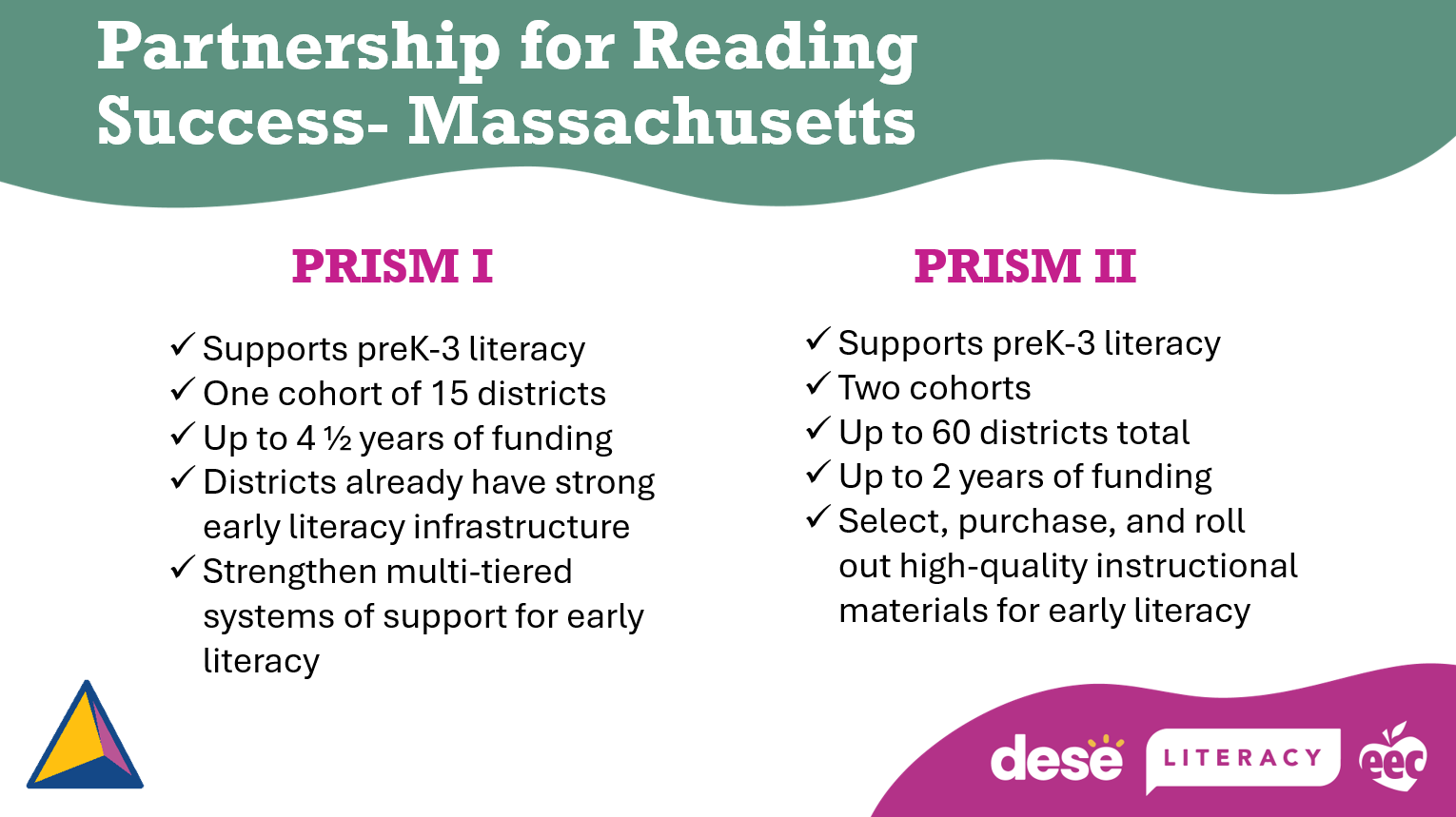
The grants, as mentioned are covering two separate implementations, dependent on the degree to which the district already has what the Department terms “early literacy infrastructure,” as follows:
The Literacy Launch teacher professional development included 500 educators last summer, and 1,300 this school year. Sign-ups for this summer’s opportunity will be coming soon. Schools in which there is a high degree of interest and a significant number of educators who have participated become eligible for literacy coaching from the state for free.
There is a $25M “high dosage tutoring” fund from Fair Share funds which are integrated with other literacy interventions and actions in districts
Vice Chair Hills asked about “at least annual” metrics, and asked if the goals set by the PRISM I grant–
• 80% of students meet reading benchmarks by the end of each grade K-3
• 33% increase in the percentage of students meeting or exceeding MCAS expectations
• Reduce disparities in the percentage of students meeting or exceeding screening benchmarks and MCAS expectations
—were “aggressive,” comparing them to Mississippi. He was told “relatively few” of the districts involved have close to 80% of third graders meeting benchmarks.
Member Marty West asked how “‘evidence-based materials'” was being defined as, if the Legislature agrees on a literacy bill requiring state determinations on curricula, there will be state responsibility. He was told that the Department uses the term “high quality instructional materials, [as]…very few materials on the market have evidence of efficacy,” so it is curricula that are built using materials that have evidence of working. In order to be listed as “high quality instructional materials,” a curriculum must first be rated highly be EdReports, which makes it eligible to be considered by the Department’s CURATE; if it is highly rated there, it may be considered for inclusion as “high quality instructional materials.”
Member Farzana Mohamed argued that it “isn’t okay for one in five children” to not be able to read “after this investment.
The Board next received a presentation on proposed new regulations and amendments to current regulations as a result of the Protect Education Equity Act. The presentation given at the meeting can be found online here.
The proposal is to amend current special education regulations, adding the word “state” in one section and creating a new section on student discipline. Also, the proposal is to add a new section on interpretation and translation services in schools.
The Board voted to send the proposals out for public comment; public comment will be open until April 24. The regulations are expected to come back for a Board vote in June.
Finally, the Board received an update on the FY27 budget as proposed by Governor Healey last month, as the Board met just before it was proposed. MASC’s Public Policy Report on that proposal can be found here. Additionally, both the Commissioner and DESE CFO Bill Bell cautioned about federal grants for the upcoming year. While the federal budget does level fund most entitlement grants, those are subject to allocations determined by student enrollment, among other demographics. It may be that both the Commonwealth and districts may see smaller allocations.
The Board adjourned. They next meet March 24.